

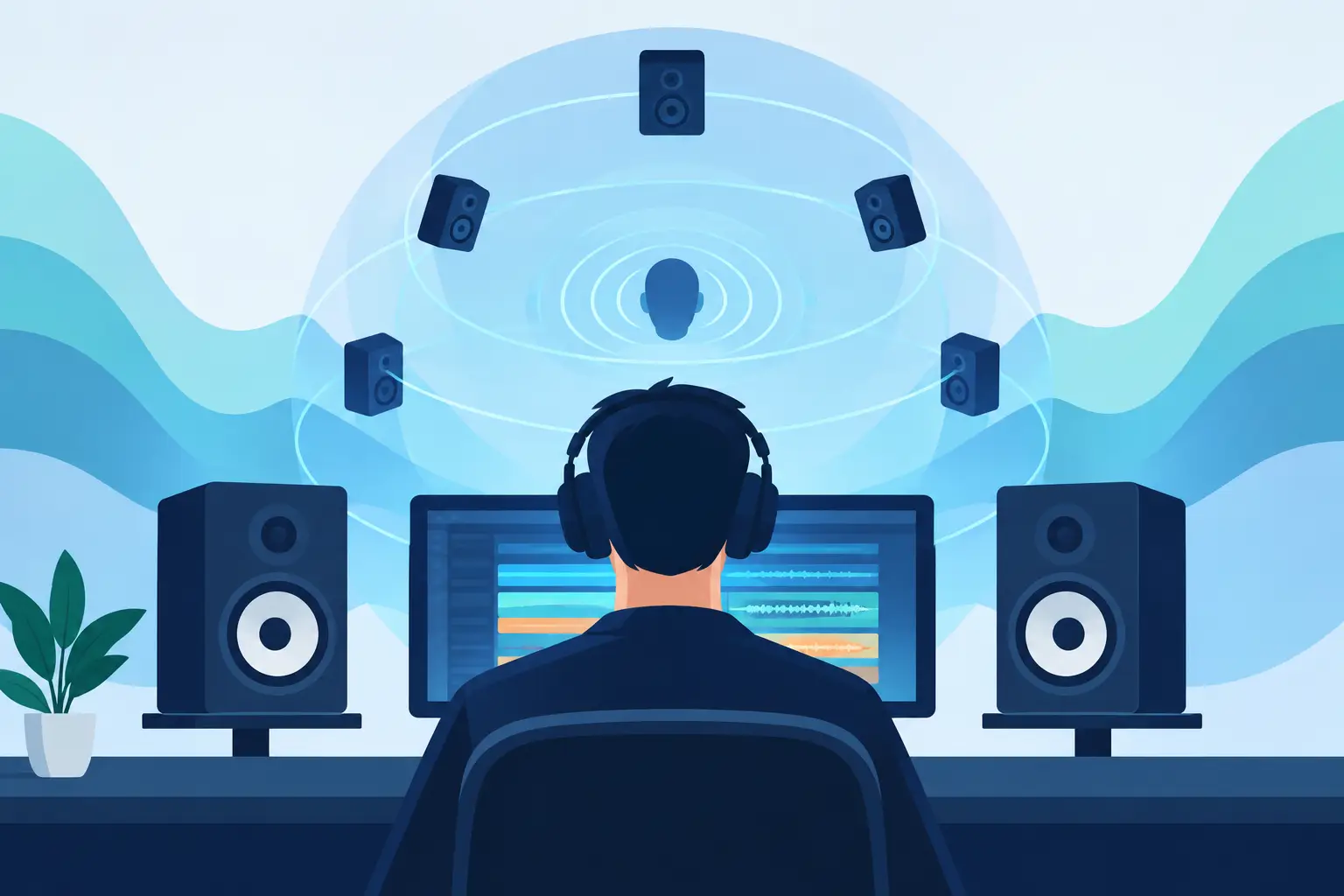
A listener can now move from a pair of earbuds to a soundbar, a car system or a multichannel cinema-style setup without changing the track. That shift is driving immersive audio production trends, but it has also created a familiar studio problem: how do you make a mix feel expansive without losing the punch, focus and emotional intent that made the performance worth recording?
For artists and creators, immersive audio is no longer only a specialist format for major-label releases or large post-production houses. The tools are more available, and audiences are encountering spatial playback in everyday devices. Yet the best results still begin with the same fundamentals: a compelling performance, sensible recording choices and a mix that translates beyond one impressive listening setup.
Immersive audio production trends are moving upstream
The biggest change is not simply that mixers are placing sounds behind or above the listener. It is that spatial thinking is beginning earlier in the session. Instead of treating immersive delivery as an extra export at the end, producers are considering space while arranging, tracking and editing.
A live band, for example, may be recorded with a close-miked kit and amps for control, then supported by carefully placed room microphones to capture depth and movement. A vocalist might stay firmly present at the front, while harmonies, delays and texture occupy a wider field. For a podcast or presenter-led piece, atmosphere can place a voice in a believable environment without making speech harder to follow.
This does not mean every source needs to fly around the room. Often, the most effective immersive mix is restrained. Stable anchors give the listener confidence, while a few well-chosen elements create dimension. When everything moves, nothing feels special.
Capture choices now protect future options
Recording clean individual channels remains vital, particularly for live sessions. Multitrack capture gives a mix engineer freedom to shape the spatial picture later, rather than committing to a busy stereo balance on the way in. Room mics, audience mics, percussion details and natural reverb can become valuable storytelling tools when the production calls for them.
That said, more microphones are not automatically better. Extra channels bring phase relationships, spill and editing time. In a small live room, a pair of well-positioned ambient mics can be more useful than several microphones added without a clear purpose. The question is not “Can we record this?” but “Will this add a meaningful layer to the final experience?”
Binaural listening is the practical test
Many people will first hear an immersive mix through headphones. Binaural rendering uses headphone playback to suggest width, depth and elevation, making it central to how immersive releases are judged in the real world.
For musicians, this can be exciting. A fingerpicked guitar can feel close enough to touch, a backing-vocal stack can open around the lead, and a live performance can carry some of the room’s energy rather than feeling sealed behind the speakers. For spoken-word creators, it can make location sound and scene-setting details more involving.
But headphone playback exposes weak decisions quickly. Hard-panned or over-processed material can become distracting. Reverbs that sounded glamorous on monitors may blur the lyric. Low-end information placed too widely can lose authority. Check the binaural version regularly, but do not build a mix solely around one pair of headphones. Different playback systems interpret spatial metadata differently, and listener preferences vary.
A reliable approach is to make the core musical message work in stereo first, then use immersive tools to add scale, separation and drama. Stereo is not obsolete. It remains the reference point for a great deal of listening, social video and independent release workflows.
Object-based mixing brings control, not a shortcut
Modern immersive formats commonly work with a combination of beds and objects. A bed carries grouped material in a defined speaker layout, while objects can be positioned and automated with more precision. This opens creative possibilities that conventional left-right mixing cannot offer.
A producer might keep drums and bass grounded in a stable bed, then move a delayed guitar phrase or an atmospheric synth as a deliberate event. In a filmed live session, that movement can complement a change in camera angle or a moment when the arrangement opens up. Used with care, it makes audio and picture feel connected rather than merely captured at the same time.
The trade-off is complexity. Object automation needs to serve the song, and sessions need careful organisation. Labels, version control and clear notes become more important when a project includes stereo masters, immersive masters, video edits and alternate deliverables. A well-organised production is not less creative. It leaves more headspace for the decisions listeners will actually notice.
Dynamics and silence are becoming part of the space
Immersive formats reward contrast. If every instrument occupies maximum width, elevation and loudness from the first bar, there is nowhere for a chorus or final section to grow. Producers are increasingly using silence, narrower verses and drier moments to make the arrival of space feel intentional.
This is especially effective in acoustic music, vocal-led tracks and performance films. The sound of a room before the first note, a breath between lines, or the natural decay after a final chord can tell an audience that they are hearing people in a real place. Those details need sensitive gain staging and editing, not artificial exaggeration.
Live and video production are converging
Immersive audio is closely tied to the rise of high-quality performance content. An artist may need a release-ready track, a multi-camera video, short social clips and a livestream from the same session. Planning audio and video together avoids compromises later.
If a camera is close to a drummer, for instance, the sound mix can feature a particular cymbal swell or tom fill at that moment without becoming gimmicky. If a presenter walks through a space, dialogue capture and room tone should be designed so the change in perspective feels natural. Green-screen content brings its own challenge: without a real acoustic setting visible on screen, the audio must avoid implying a room that does not fit the picture.
Livestreams are a more cautious case. A fully immersive broadcast may not be the right use of budget or bandwidth for every event. A clear stereo stream, strong vocal intelligibility and dependable monitoring will usually matter more. However, recording a clean multitrack alongside the stream creates the option to produce an immersive version afterwards, when there is time to make proper mix decisions.
Translation matters more than novelty
The most useful immersive audio production trends are not about making a listener turn their head. They are about making a recording clearer, more physical and more emotionally involving across multiple formats.
Translation checks should include speakers, headphones, a mono fold-down and the ordinary devices your audience actually uses. Listen for whether the lead vocal stays intelligible, the kick and bass retain weight, and essential hooks remain audible when spatial information is reduced. A dramatic effect that disappears in stereo may still be worthwhile, but it should not carry the entire song.
For independent artists, budget matters too. A thoughtful stereo mix with a well-recorded performance will beat a rushed immersive version every time. The stronger route is often to track with enough detail and separation to keep the immersive option open, then decide in post-production whether the song, release plan and intended audience justify the extra mix stage.
Build a session around the listener’s journey
Before recording, decide what the listener should feel closest to. Is it the lead vocal in an intimate ballad, the collective energy of a band in a room, the impact of a beat, or the sense that a presenter is speaking directly to them? That answer shapes microphone placement, arrangement, monitoring and spatial treatment far better than chasing a format label.
At Yougig, the combination of a large live room, dedicated mix facilities and multi-camera production makes it possible to preserve that choice from first take through to final edit. Record the performance with character, keep the session flexible, and let the format support the idea rather than dictate it.
The next useful immersive mix may not be the one with the most movement. It may simply be the one that makes a listener stay with the song for one more breath before pressing play again.