

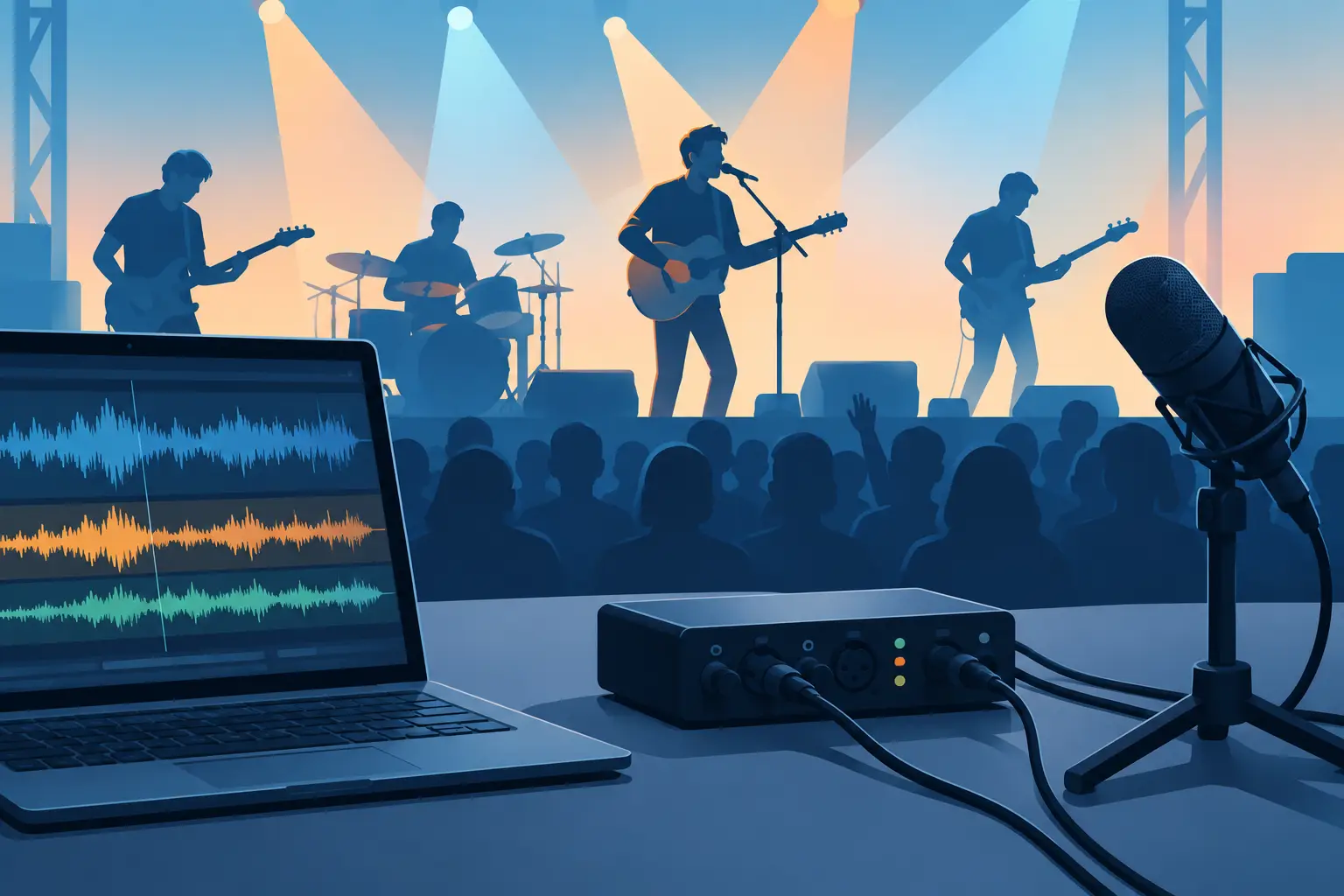
A great take often happens just after a band stops trying to make one. The singer turns towards the drummer, the groove settles, and a small imperfection makes the chorus feel human rather than assembled. Live sound recording is about preserving that moment without letting technical distractions flatten it.
For bands, vocalists, beatbox artists and performers, recording live can be the difference between a track that sounds correct and one that feels convincing. It asks more from the room, the monitoring and the engineer than recording every part separately. It also gives you something hard to manufacture later: real interaction.
What live sound recording actually captures
Live sound recording means capturing performers playing together, in the same session, rather than building a production one isolated layer at a time. That may mean a full band in one room, a singer and guitarist performing face to face, or a rapper delivering to a beat while a beatbox artist creates live textures beside them.
It does not have to mean abandoning control. A well-planned session can record separate microphone channels for each instrument while retaining the shared performance. This is multitrack live recording: everyone plays at once, but the mix can still be shaped afterwards. A vocal can be balanced, a guitar part can be softened, and a drum kit can be given the space it needs without losing the timing and communication that happened in the room.
The trade-off is simple. More separation gives the mix engineer greater freedom, while more bleed between microphones often delivers a more natural, connected sound. Neither approach is automatically better. A loud rock band may need careful isolation and close miking. An acoustic trio may benefit from hearing more of the room and each other.
The room is part of the recording
A live room is not just somewhere to put amplifiers. Its size, surfaces, ceiling height and acoustic treatment all affect what reaches the microphones. A room that feels comfortable to play in usually helps performers relax, but comfort alone is not enough. You need a space that can handle volume, keep unwanted reflections under control and allow clear sightlines between players.
For a drummer, the room can add weight and excitement to cymbals and toms. For a vocalist, too much hard reflection can make a performance harder to pitch and harder to mix. For guitarists, amp placement matters as much as amp settings. Moving an amplifier half a metre, angling it away from a reflective wall, or lifting it from the floor can change the recorded result significantly.
This is why a quick soundcheck should be treated as part of the creative process, not dead time before the real work begins. Play a section at proper performance level. Walk around the room. Listen for rattles, harsh cymbals, booming bass notes and headphone spill. Solving these issues before recording is faster and cheaper than trying to disguise them in editing.
At Yougig, the large live recording room and separate digital mixing suite make it possible to keep the performance moving while the technical side stays properly managed. The floating-studio setting also offers something many conventional rooms do not: a calm change of scene that lets people arrive, settle and focus on the work.
Build the headphone mix around confidence
Performers do not need identical headphone mixes. In fact, giving everyone the same balance is one of the quickest ways to make a live session feel uncomfortable.
A singer may need the vocal slightly louder, with enough reverb to perform naturally but not so much that pitch becomes vague. A drummer may want more bass and a strong guide vocal. A guitarist may need less of their own amp than expected and more kick drum to lock in. The best cue mix is the one that makes each person play with confidence.
Agree on a communication method before the first full take. It can be as simple as a talkback microphone and clear hand signals. If someone needs less click, more vocal or a restart, that should be easy to ask for without shouting across the room. Tiny interruptions become frustrating when they are repeated ten times.
Clicks are useful, but they are not compulsory. If the song needs a tempo map, programmed elements or later overdubs, a click is usually sensible. If the arrangement breathes around the vocal and the band has a strong internal pulse, recording without one may produce the better performance. The decision should serve the song, not the spreadsheet.
Microphones should serve the source
There is no single microphone list that guarantees a professional live recording. The right choice depends on the voice, instrument, volume, arrangement and room. What matters most is that each microphone has a purpose.
Close microphones give focus and control. They are particularly useful on drums, guitar cabinets and louder vocal performances. Room microphones add scale, depth and a sense of place, but they should be positioned with intention. If the room sounds exciting, capture it. If it sounds cluttered, prioritise cleaner close signals and create ambience during mixing instead.
Phase is one of the less glamorous details that makes a large difference. When multiple microphones hear the same source at slightly different times, some frequencies can cancel each other out. The result may be a snare that loses punch or a guitar tone that feels strangely thin. Checking polarity, microphone distance and the relationship between drum mics before committing to long takes protects the energy you worked to create.
A good engineer will also leave enough headroom. Digital recording is forgiving in many ways, but clipped transients are not musical. A take can be loud later. It cannot be repaired easily if the loudest chorus has distorted on the way in.
Rehearse the recording, not just the songs
Knowing a song and being ready to record it live are related but different things. The band should know where intros end, how long stops last, who gives the count-in and what happens if a string breaks or a verse goes wrong. These details sound obvious until a brilliant take collapses because everyone made a different decision at the same moment.
Use rehearsal time to test transitions at performance level. If backing vocals only arrive in the final chorus, practise how the singers move towards their microphones. If a keyboard player changes sounds, check that the patch is ready before the bar where it is needed. If the song has a dramatic ending, decide whether it finishes cleanly, rings out, or leaves room noise as part of the atmosphere.
Recording two or three complete takes can be more productive than spending an hour correcting a tiny section. Full takes reveal the arc of a performance. They also give you options: the urgency of take one, the tightness of take two, and perhaps a perfect final chorus from take three. Punch-ins have their place, but they should support a strong performance rather than replace one.
Leave room for the human details
The most shareable live sessions often contain details that would be removed from a heavily polished studio production: the drummer’s breath before a fill, a guitarist’s fingers shifting on the fretboard, a brief smile between performers. The point is not to make a recording messy. It is to avoid sanding away everything that proves real people were in a room, making a decision together.
That applies to live video too. A multi-camera capture can preserve eye contact, movement and the build-up before a chorus in ways that a finished audio track cannot. When audio and video are planned together, microphone positions, cabling, lighting and camera angles can be organised before the first take, keeping the room clear and the session focused.
Give the mix a clear brief
Once the performance is captured, mixing should reinforce its character. Tell the engineer what you want listeners to feel, not only which records you admire. Do you want the vocal intimate and close? Do you want the drums to feel like they are in the room with the listener? Should the bass be warm and rounded, or sharp enough to carry a live electronic arrangement?
Reference tracks can help, but they are a starting point rather than a set of instructions. Your arrangement, voices and room are different. A mix that works for a sparse acoustic performance may not work for a six-piece band with dense guitars and layered backing vocals.
Leave time to listen back away from the live room. A track that feels enormous on studio monitors may reveal a harsh vocal or overbearing cymbals on headphones. Check a sensible range of playback systems, then make changes carefully. Chasing every difference between speakers can lead to a mix with no centre of gravity.
The useful question at the end of a session is not whether every tiny flaw has disappeared. It is whether someone hearing the recording can feel why the performers wanted to play that song together. Set up the room, make the monitoring personal, and give yourselves enough complete takes for that answer to come through.