

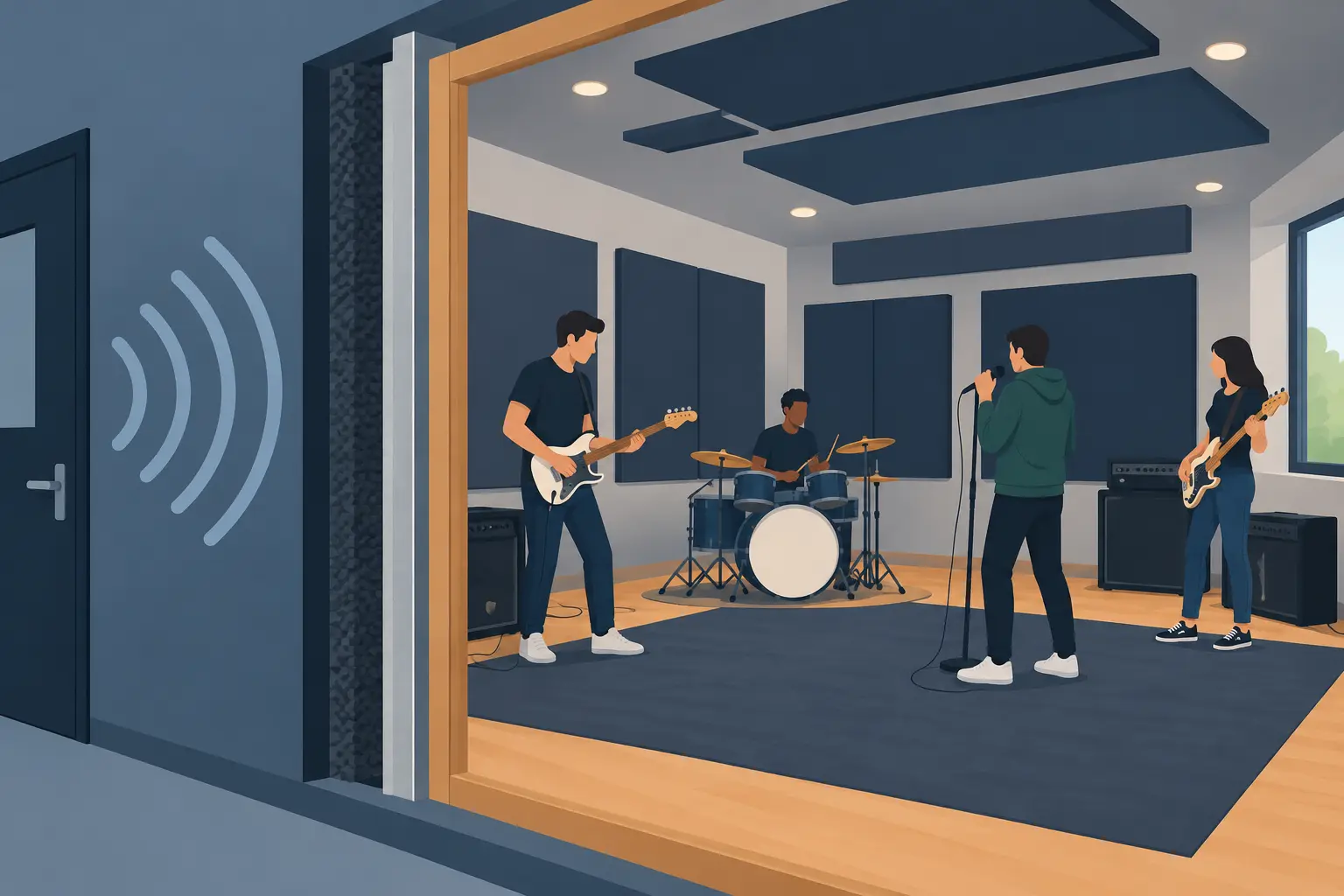
A drummer counts in, the bass amp wakes up and the singer finally has enough level to hear themselves. That is the point of hiring a proper room – but are rehearsal rooms soundproof enough to let a band play freely? Usually, they are designed to control sound far better than a spare room, garage or front room. Complete silence outside the building, however, is a different and much rarer promise.
For musicians, the useful question is not simply whether a room is “soundproof”. It is how much sound it keeps in, how it behaves when the band gets loud, and whether you can concentrate on the performance rather than continually holding back.
Are rehearsal rooms soundproof in the literal sense?
Most professional rehearsal rooms provide some degree of sound isolation. Their walls, doors, ceilings and building layout are intended to reduce the amount of amplified music that travels to neighbouring rooms and properties. A well-planned space can make the difference between a focused full-volume rehearsal and a session spent turning down after every chorus.
But soundproofing is not an on-off switch. Sound moves through air, solid structures, door gaps, ventilation routes and even a building’s framework. Low frequencies from kick drums, bass guitars and synths are especially persistent because they carry energy through floors and walls more readily than the higher frequencies of a vocal or cymbal.
That means a room may be suitable for a loud rock, metal, rap or electronic session without being totally inaudible outside it. The best studios are honest about that distinction. They manage isolation carefully, set sensible hours and work with musicians to keep sessions enjoyable for everyone nearby.
Soundproofing and acoustic treatment are not the same thing
These two terms are often used interchangeably, but they solve different problems.
Soundproofing, more accurately called sound isolation, concerns what leaves or enters the room. It relies on mass, sealed construction, separation between surfaces and careful treatment of weak points such as doors, windows and cable routes. The goal is to reduce sound transmission.
Acoustic treatment concerns what happens inside the room. Absorption, diffusers, rugs, acoustic panels and sensible room proportions help reduce harsh reflections, excessive reverberation and confusing build-up. The goal is a room where you can hear what you are playing.
A rehearsal space can be heavily treated yet leak sound badly. It may feel pleasantly controlled inside, but a poorly sealed door or lightweight wall can still let plenty of noise out. Equally, a room can be well isolated but acoustically uninspiring if every surface is hard and reflective.
For a productive band session, you want both. Isolation gives you the confidence to perform. Good acoustics help you make better musical decisions – whether that is tightening a stop, balancing a vocal harmony or noticing that a guitar tone is masking the keyboard part.
What makes a rehearsal room quieter outside?
Professional isolation is usually built from a number of measures working together rather than one magic material. Dense, layered construction can help block airborne sound, while decoupled surfaces reduce vibration travelling through the structure. Properly fitted acoustic doors and sealed edges matter enormously because sound will find the smallest gap.
Ventilation is another practical consideration. A room needs fresh air, particularly when several musicians are working under lights with amplifiers running. Yet any opening can become a route for sound. Better-designed spaces use controlled ventilation paths rather than relying on an open door between songs.
The building itself also matters. A rehearsal room within a busy commercial setting has different challenges from one near homes, and a ground-floor space behaves differently from an upstairs room. This is why two rooms that look similar in photographs can have very different usable volume levels.
At Yougig, the aim is a live-room experience where performers can settle in, play with energy and capture the work when inspiration arrives. That relies on more than equipment: it means thoughtful session planning, a comfortable working environment and respect for the location around the studio.
How loud can you realistically rehearse?
It depends on the line-up, the arrangement and the room. An acoustic duo, spoken-word performer or podcast team has very different needs from a five-piece band with a hard-hitting drummer and two valve amps. A beatbox artist may produce sudden, powerful low-end transients; an electronic act may need monitoring that translates reliably without overwhelming the space.
The most useful rehearsal rooms let you work at a musically natural level, not necessarily at the maximum volume every instrument can produce. Louder is not always clearer. When amps are pointed straight at players’ knees, cymbals are washing over the vocal mic and the bassist cannot hear pitch, turning everything up tends to make the problem worse.
Try positioning guitar cabinets across the room rather than firing directly at another player. Raise or tilt them so the speaker reaches ear height. Keep bass levels full but controlled, and give the vocalist a monitor position that is not competing with the drummer’s cymbals. Small changes in placement often create a far more usable mix before anyone touches a volume knob.
If you need stage-level energy for a live capture, video shoot or multitrack recording, tell the studio in advance. An engineer can help shape the setup around the result you need, whether that is raw rehearsal footage, a polished live session or stems ready for mixing.
Questions to ask before you book
Rather than asking only “is it soundproof?”, ask what kind of sessions the room is intended to host. A helpful studio should be able to explain whether full bands rehearse there, what rehearsal hours apply and whether there are practical limits on drum kits, amplifiers or extended low-frequency playback.
It is also worth asking what is included. A self-service rehearsal may suit a band that knows its setup and wants uninterrupted time to prepare for a gig. If you are arranging microphones, recording a performance or filming multi-camera content, an engineer-led session can save time and prevent avoidable technical compromises.
Ask about backline, PA, microphones and monitoring if these are relevant to your session. Bringing fewer items can make load-in calmer and leave more of the booked time for playing. For bands travelling from Brighton, Shoreham-by-Sea, elsewhere in Sussex or London, those details can be the difference between arriving flustered and starting on time.
Finally, be upfront about the project. A gentle first rehearsal, a loud pre-tour run-through, a vocal overdub session and a livestream all need different levels of isolation, monitoring and technical support. Clear information helps the studio put you in the right room and helps you get the result you came for.
Getting the best from a shared creative space
Sound isolation gives musicians freedom, but it does not remove the need for good studio etiquette. Arrive in time to set up without eating into the creative part of the session. Keep doors closed while playing, especially during full-band sections. Take breaks that give ears a reset, and use those breaks to make decisions about arrangement rather than simply pushing the level higher.
Protect your hearing, too. Rehearsal is repetition, and long exposure to high sound pressure levels can leave ears fatigued before the session is over. Earplugs designed for musicians can reduce level while preserving more of the tonal balance than basic foam plugs. Even a short quiet break can make the next run-through more accurate.
If the room starts to feel harsh or muddy, treat that as useful feedback rather than a reason to battle on. Reposition players, adjust amp direction, reduce the most aggressive frequency source or ask for help with monitoring. The goal is not to prove how loud the band can be. It is to leave sounding tighter, more confident and ready to perform.
A good rehearsal room should let the outside world fade into the background while your set comes into focus. Bring the volume when the music calls for it, bring a plan for the details, and give yourselves enough space to hear the performance becoming what it needs to be.