

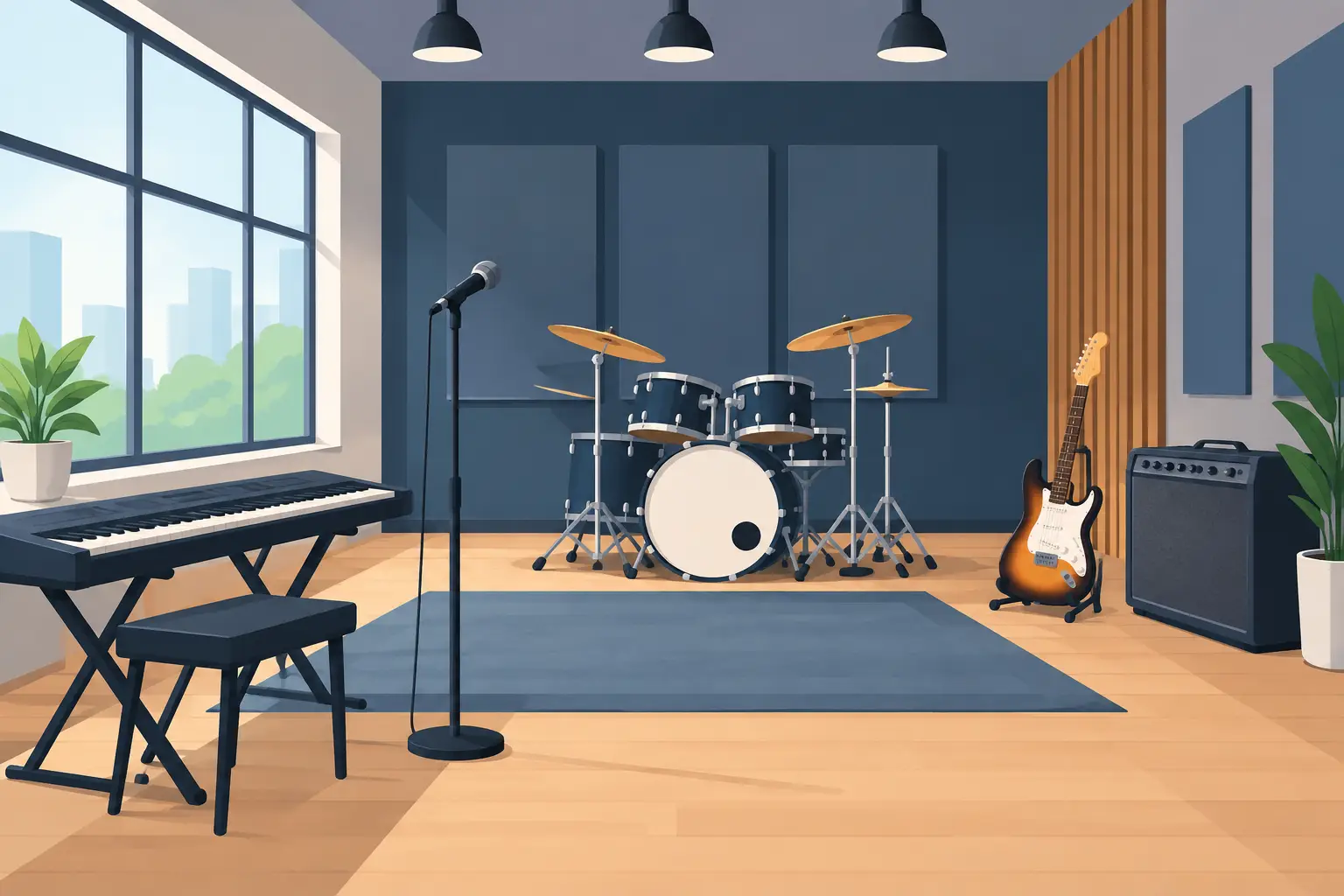
A rehearsal can fall apart before the first chorus if the room is too cramped, the vocal PA is struggling, or half the session disappears into setting up. The best rehearsal rooms give musicians space to play properly, hear the detail and leave with real progress – whether that means a tighter set, a new arrangement or a performance ready to capture.
For artists across Shoreham-by-Sea, Brighton and Sussex, the room matters more than people sometimes admit. It shapes how long you can focus, how confidently you can try ideas and whether rehearsal feels like a chore between gigs or a useful part of making better work.
What a good rehearsal room needs to do
A rehearsal room does not need to be luxurious. It does need to work. You should be able to get in, set up with minimal fuss, play at a meaningful volume and hear what your group actually sounds like together.
That starts with enough physical space. A three-piece can make excellent use of a compact room, but adding a second guitarist, keys, backing vocalists or a full drum kit changes the calculation quickly. If everyone is pressed against an amp, movement becomes awkward and communication suffers. Give the players room to settle into their natural positions, particularly if you are preparing for a live show.
Sound is the next consideration. A room should let you hear the relationship between instruments rather than turning everything into a blur. Drums, guitar amplifiers and bass can quickly dominate a poorly arranged space. Useful rehearsal is not about playing quietly; it is about placing equipment sensibly, managing volume and giving vocals a chance to sit above the band without being forced.
A dependable PA and vocal microphones are equally valuable. Lead vocals are often left until late in a rehearsal because the singer cannot hear themselves properly. That makes it harder to practise harmonies, work on phrasing or judge how a song will land in front of an audience. If vocals matter to the performance, they need to be part of the session from the beginning.
Choosing rehearsal rooms for your project
The right choice depends on what you are trying to achieve that day. A band running a 45-minute festival set has different needs from a songwriter testing arrangements, a rapper practising with playback, or a beatbox artist preparing a filmed live take.
Check the practical essentials first
Before booking, establish what is included and what you will need to bring. A clear room specification saves the familiar last-minute scramble for stands, leads and an adapter that nobody packed. It also helps you budget honestly: a low hourly price is only useful if the room contains the basics your session requires.
Look for clarity around drum kit availability, PA provision, microphones, amplifiers, stands and monitoring. Ask whether you can use your own backline and whether there is time built in for changing over. Bands with a complex setup may benefit from booking a slightly longer slot rather than trying to make a two-hour rehearsal do the work of three.
Access and timing are less glamorous, but they matter. If the space is difficult to reach with gear, has limited loading access or ends at a time that cuts your rehearsal short, it can drain the energy from the evening. A good room lets you arrive, get comfortable and use the time you are paying for.
Think about the atmosphere as well as the equipment
Some musicians thrive in a stripped-back, functional room. Others write better when the setting feels calm, personal and removed from the usual noise. Neither preference is wrong, but it is worth recognising that the environment affects performance.
A welcoming studio can encourage artists to take risks: try a new tempo, swap an instrument, sing the difficult harmony again or play an unfinished song in front of the band. That freedom is especially useful for emerging artists who are still finding their sound. A room should feel professional without making anyone feel they have to perform perfection from the first take.
At Yougig, the live room sits on a Shoreham-by-Sea houseboat, combining practical rehearsal space with the change of pace that a waterfront setting can bring. It is a reminder that a rehearsal space can be properly equipped without feeling clinical.
Match the room to the next step
The strongest rehearsal sessions often have a clear destination. Perhaps you have a headline set in two weeks, a live session to film, or a studio recording booked later in the month. Choosing a room with recording and video capability can make that transition easier.
This does not mean every rehearsal needs an engineer or a full multitrack recording. Sometimes a simple reference recording is enough to reveal a rushed bridge, muddy guitar sound or chorus that needs another vocal line. But when a song is close, being able to move from rehearsal into quality audio capture or multi-camera performance video can preserve the momentum.
Make rehearsal time do real work
Turning up and playing through the same set is enjoyable, but it can leave important problems untouched. A little structure helps, particularly when rehearsal time is shared and everyone has competing ideas.
Start by agreeing the priority for the session. It could be learning two new songs, tightening transitions, building a set list, fixing the ending of one track or preparing for a filmed performance. Keep that priority visible. If a conversation about a new pedal sound begins to take over, you can decide whether it serves the session or belongs in the final ten minutes.
Run songs as if they are happening in public. Do not stop at every small error. Make a note, finish the song and discuss the issue while everyone can remember it. Stopping repeatedly tends to break the musical flow and trains a band to expect interruptions. There are exceptions, of course: if a section is structurally wrong or someone has genuinely lost their place, pause and sort it out. The point is to make stopping a choice, not a reflex.
Record at least one full run-through on a mobile phone or portable recorder. The sound will not be a final mix, and it does not need to be. Listening back the next day gives you a more honest view of timing, tuning, dynamics and arrangement than memory alone. It can also show whether the song has enough contrast between verse, chorus and middle section.
Leave a few minutes at the end for decisions. Confirm tempos, set order, key changes and any jobs that need doing before the next session. A short voice note or shared message prevents the familiar situation where everyone remembers a different version of the plan.
When rehearsal becomes content
For many artists, rehearsal is no longer only preparation for a gig. It can be the place where social clips, audition footage, electronic press material or live performance videos begin. The key is to decide whether you are rehearsing for the camera or simply documenting the process.
If you want polished content, allow time for it. Performers need to consider where they stand, how they enter a song, whether microphones obscure faces and how the energy reads beyond the room. A multi-camera shoot benefits from a rehearsal that has already settled the musical essentials, rather than trying to solve performance and production problems at once.
For presenters, podcasters and solo creators, the same principle applies. A rehearsal room with production support can be a useful place to test delivery, practise interviews, record a pilot or refine a livestream format before it goes out live. Good preparation makes the final result feel effortless, even when plenty of careful work sits behind it.
Respect the room and the people in it
A rehearsal space works best when every artist treats it as shared creative infrastructure. Keep drinks away from equipment, coil leads rather than leaving them underfoot, and allow enough time to pack down properly. If something is not working, tell the studio team rather than trying to force a damaged connector or make a risky repair.
Most importantly, listen to one another. The room is there to make louder playing possible, but volume is not the same as impact. When each player can hear the song, the arrangement becomes clearer, the groove gets stronger and rehearsal starts to feel less like preparation for the real thing. It becomes part of the real thing itself.
Book the space that suits the work in front of you, arrive with one useful goal, and give the songs enough room to show you what they still need.