

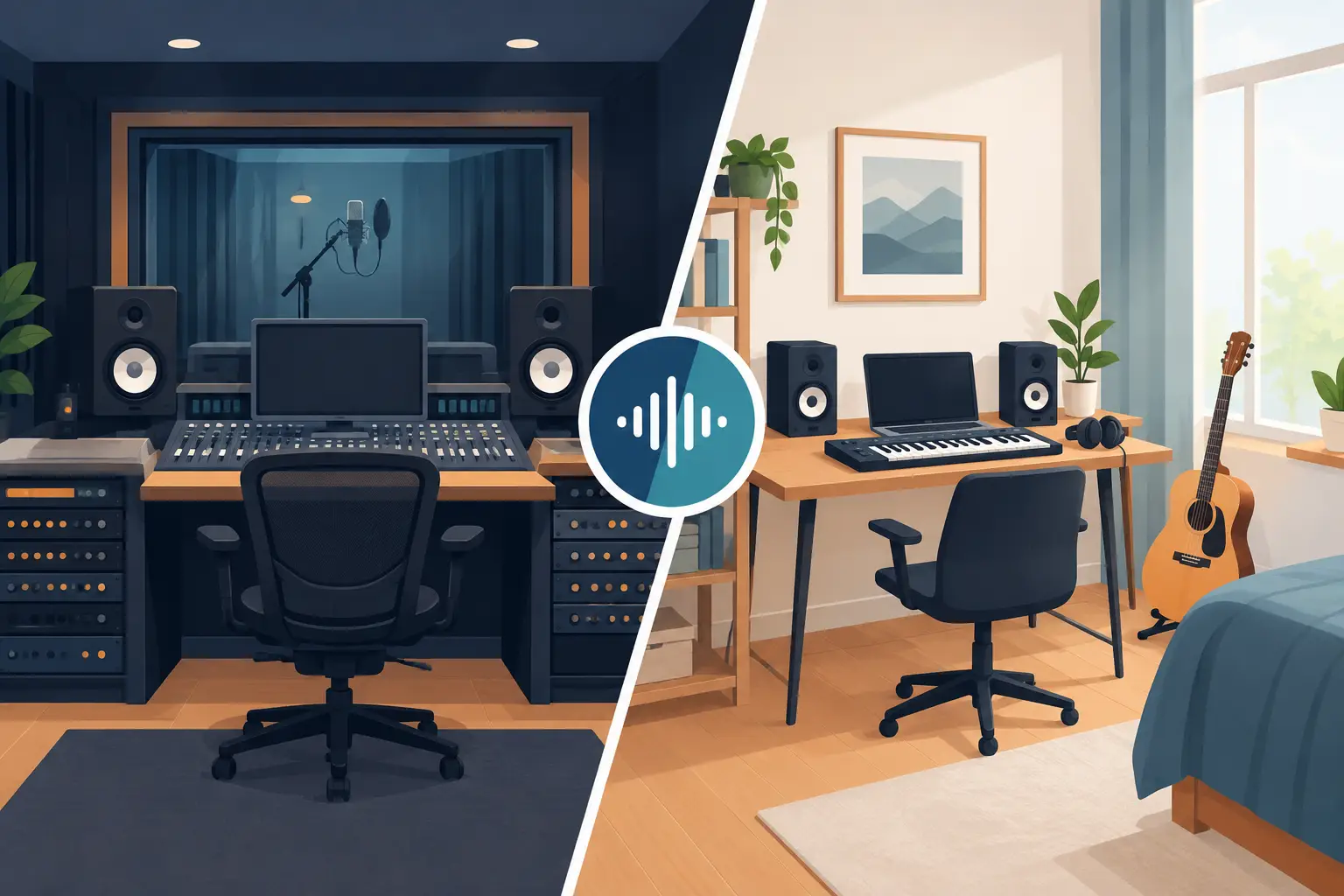
A vocal that feels electric in your bedroom can suddenly sound small when played beside a commercial release. Equally, a songwriter can spend a costly afternoon in a recording studio and leave wishing they had given the arrangement another week. The recording studio versus home studio question is not really about which option is better. It is about what your project needs at this particular stage.
For some artists, home is where the ideas arrive quickly and without pressure. For others, stepping into a purpose-built room is the moment the performance becomes real. Both can be part of a strong creative process, provided you understand where each one helps and where it asks you to compromise.
Recording studio versus home studio: the real difference
The biggest difference is not simply the microphone on the stand or the software on the screen. It is the environment around the recording. A professional studio gives you a space designed to capture sound predictably: a treated live room, controlled monitoring, suitable microphones, reliable signal paths and an engineer who can hear problems before they become expensive fixes.
A home studio gives you proximity. You can record at midnight, reshape a lyric after breakfast and make twenty versions of a synth part without watching the clock. That freedom is valuable, especially for writing, programming, sound design and building demos. If you know your room and work carefully, you can make recordings with real character there.
The trade-off is that domestic rooms are rarely built for critical listening or loud performance. Reflections from bare walls, low-frequency build-up in corners, passing traffic, boilers, neighbours and a laptop fan all find their way into a take. You may not notice them while recording, then hear them clearly once the song reaches mixing or mastering.
When a home studio is the right creative base
A home setup earns its place long before you are making finished masters. It is ideal for catching ideas before they disappear, practising delivery, testing keys and tempos, producing beats, editing podcasts and creating reference tracks for collaborators. For a solo artist who works best in private, it can remove the self-consciousness that sometimes comes with a booked session.
Home recording also lets you learn your craft through repetition. You begin to hear how placement changes a vocal, how a compressor responds to a rap performance, or why a guitar part that sounded wide in headphones feels crowded through speakers. Those lessons are hard won, but useful.
It works particularly well when the sound source is controlled. Electronic production, sampled instruments, voice-over recorded with sensible acoustic treatment and close-miked overdubs can all be very achievable. A decent microphone, an interface, closed-back headphones, basic treatment and disciplined gain levels will take you further than a room full of unnecessary gadgets.
Still, home recording has a hidden cost: decision fatigue. You are the performer, producer, engineer, editor and person making tea. That can be liberating, but it can also keep a track in permanent revision. A musician who is excellent at writing does not need to become an acoustician, camera operator and mix engineer to make work worth hearing.
Be honest about noise and neighbours
If you need to track drums, a loud guitar cabinet, brass, full-bodied vocals or a live band, the practical limits of home become obvious quickly. Keeping peace with neighbours often means lowering the energy that makes a performance convincing. Electronic drum pads and amp simulators are useful tools, but they are not always the sound or physical response a player needs.
The same applies to video. A mobile phone can capture a compelling acoustic performance, but an untreated room with poor light and inconsistent sound can make a brilliant artist look less prepared than they are. Home is excellent for regular social content and early ideas. A key release, pitch video or live session may deserve a more controlled setting.
What a professional studio changes
Booking studio time buys more than equipment. It creates a boundary around the work. You arrive, set up, focus and commit. For a band, that shared attention can transform rehearsal-room familiarity into a performance with shape, tension and momentum.
A good live room lets musicians play at natural volume without apologising for it. Proper microphone choice and placement capture the weight of a kick drum, the detail in cymbals, the bite of an amplifier and the space around a vocal. Just as importantly, an engineer can respond in the moment. If a singer is straining, a headphone mix is distracting or a guitar is masking the chorus, somebody is listening with fresh ears.
Monitoring matters here. Mixing in a room that tells the truth makes decisions more dependable. You are less likely to overdo the bass because your room swallowed it, or brighten a vocal until it becomes harsh everywhere else. That does not make mixing effortless, but it gives the process a firmer foundation.
Professional rooms also make collaboration simpler. A producer can speak to an artist rather than troubleshoot an interface. A drummer can concentrate on the groove while someone else manages takes. For podcasts, interviews, presenter-led video and livestreams, a crew can look after levels, cameras, lighting and recording redundancy while the contributors stay present.
At Yougig, that can mean moving from a large live recording room into dedicated mixing and editing, or pairing audio capture with multi-camera video in the same project. That joined-up approach is useful when a live performance needs to work as both a great-sounding track and a watchable piece of content.
The cost question is more nuanced than hourly rate
A home studio appears cheaper because the room is already yours. Over time, though, purchases add up: microphones, stands, cables, interfaces, headphones, monitors, treatment, storage, repairs and software subscriptions. Then there is your time. How many evenings will you spend fixing a buzz, learning a new plug-in or trying to rescue an unusable room sound?
A professional recording session has an obvious hourly cost, which can make it feel like a bigger commitment. But it may be more economical if you arrive prepared and use the room for the jobs that genuinely require it. Recording drums, final lead vocals, live instruments, interviews or a multi-camera performance in one focused session can save days of compromises at home.
The practical answer is often a hybrid workflow. Write and pre-produce at home. Build guide tracks, refine lyrics, choose sounds and rehearse transitions. Then book studio time to capture the elements where performance, acoustics and engineering expertise make the greatest difference. Take the finished multitracks home for review if you wish, before returning for mixing or final changes.
Preparation makes paid time go further
The artists who get the most from a studio do not necessarily arrive with every detail fixed. They arrive with a clear direction. Know the song structure, bring reference tracks, restring or service instruments where needed, label sessions and agree who has the final say when choices need making.
If you are filming too, decide the purpose before the cameras roll. Is it a full live performance, a release teaser, an interview, a teaching clip or a social edit? The answer affects framing, lighting, clothing, playback and how you use the time. A well-planned session feels relaxed because the essentials have already been considered.
Choose based on the job, not the badge
There is no prize for recording every sound at home, and no rule that says a professional studio must be used from the first chord to the final master. A rough demo made in a spare room may contain the magic that guides the whole production. A studio session may supply the sonic clarity and confidence that lets that magic reach listeners intact.
Ask yourself a few direct questions. Does this performance need to be loud, natural and unrestrained? Will room sound help or harm it? Do you need another pair of experienced ears? Are you recording music only, or also creating video and broadcast-ready content? Most importantly, where will you make better decisions: alone with time to experiment, or in a focused space with support on hand?
If the song is still finding its shape, give it the freedom of home. When it is ready to carry your name into the world, give it the room, attention and performance it deserves.