

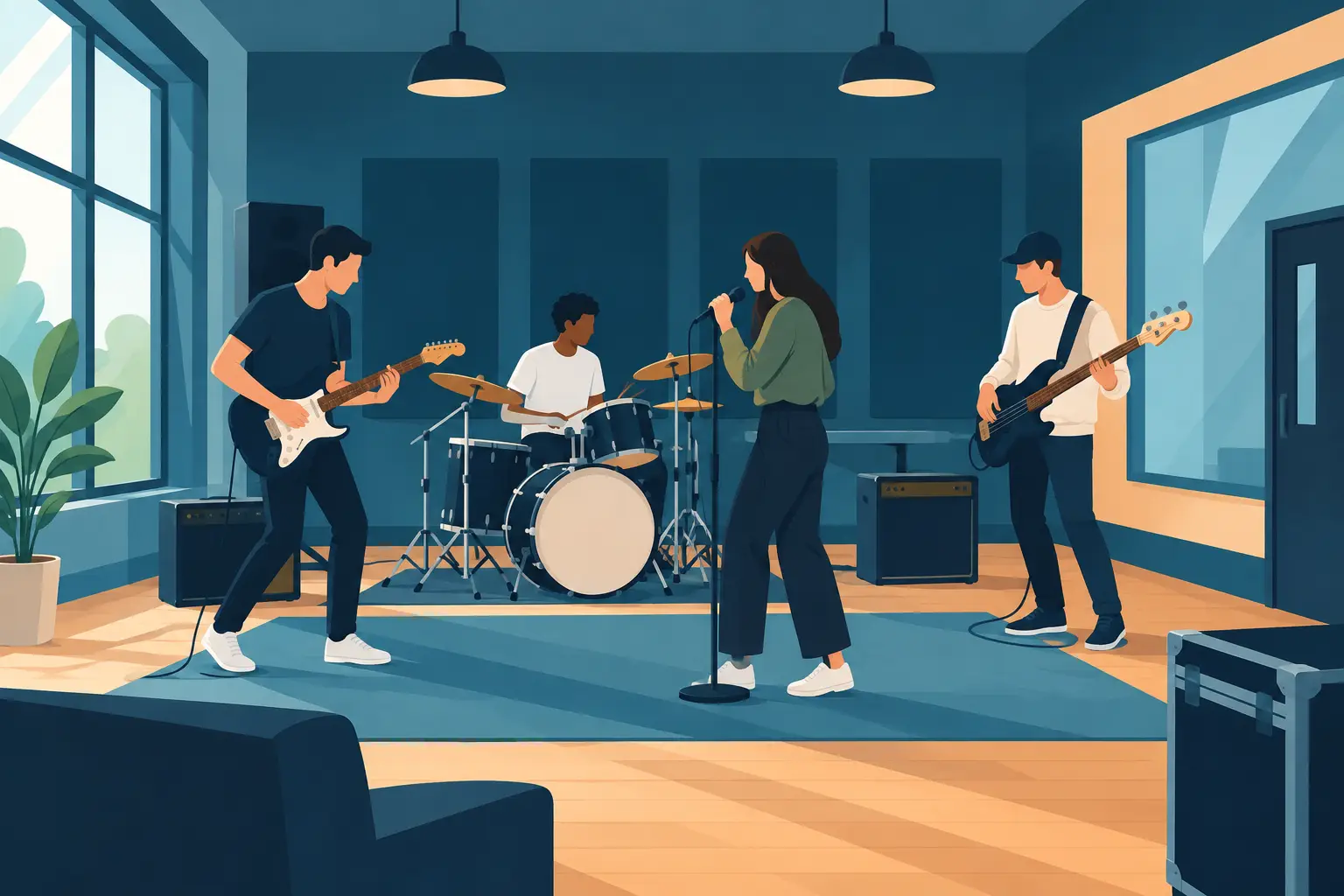
A productive rehearsal rarely begins with a checklist. It begins when everyone walks in, sets up without a scramble, hears themselves properly and gets on with playing. The right live room rehearsal hire gives your music enough room to breathe, whether you are tightening a three-minute set, finding the feel of a new track or preparing for a show with no margin for guesswork.
For bands and artists around Shoreham-by-Sea, Brighton and Sussex, rehearsal space is not simply somewhere to make noise. It is where arrangements become reliable, transitions stop wobbling and performances start to feel lived-in rather than merely practised.
What a live room changes in rehearsal
A live room is built for musicians playing together. That sounds obvious, but it matters. When drums, amps, vocals and acoustic instruments share a room with usable space and sensible sound control, you can rehearse as a band rather than as a collection of people trying to hear over one another.
The benefit is not just volume. It is communication. A singer can give a cue without shouting, a drummer can judge the energy of a chorus, and a guitarist can hear whether a new sound supports the song or swallows it. Those small decisions are hard to make in a cramped room where every instrument is fighting for the same slice of air.
There is a trade-off. A larger, more open-feeling room can reveal flaws that a bedroom practice hides: an ending that is not quite together, a bass part that drifts, a harmony that needs another pass. That is useful information. A rehearsal room should make a band sound good enough to enjoy playing, but honest enough to help it improve.
Live room rehearsal hire for real-world preparation
The best sessions have a purpose, even when that purpose is simply to reconnect with the songs. Before booking, decide what needs to be different by the time you leave. You may be building a set for a pub show, auditioning a new player, arranging a first batch of originals or testing a show designed for a camera as well as a crowd.
If you are getting ready for a gig, rehearse the joins as seriously as the songs. Start the set from the top. Practise the count-ins, guitar changes, spoken moments and the ten seconds after each ending. These are the places where a live performance either feels intentional or loses momentum.
For writers, a live room makes it easier to test ideas at proper energy. A chorus that sounded huge through headphones may need less instrumentation once a full band plays it. Equally, a quiet verse may have more tension than expected when the room is allowed to do some work. Record a quick reference if you can, then listen back after a break. Memory is generous; playback is more useful.
For solo artists, rappers, vocalists and beatbox performers, rehearsal can be about stamina and delivery rather than sheer loudness. Use the session to run a full set without stopping, refine microphone technique, work through backing-track cues or find the physical movement that supports the performance. You do not need a six-piece band to benefit from a room designed around live sound.
Choose a room that suits the session
Not every rehearsal needs the same setup. If your aim is simply to play loudly, independently and regularly, self-service time can be the most straightforward route. You retain creative control, use the room as your working space and put the budget into repetition. This suits a band that knows its setup and wants a dependable place to put in the hours.
If the session is closer to a pre-production day, recording time or a filmed performance, engineering support can change what you get from the room. Proper multitrack capture lets you examine parts separately later. A multi-camera setup can reveal the stage picture, not just the sound. That may be more than you need for a Tuesday night run-through, but it is invaluable when a release, live session or important show is approaching.
At Yougig, the useful distinction is clear: book time to rehearse when the priority is the performance, or build a session around recording, video or livestream production when you want to take the result further. The setting may be unusual, but the workflow is practical – play, listen, adjust, capture what is working.
Think beyond the number of players
Capacity matters, but it is not the only question. Consider the equipment and movement your rehearsal needs. A drummer with a full kit, two guitarists, a bassist, vocalist and keyboard player need enough room to set up comfortably and still see each other. Add camera positions, a producer or an extra vocalist and the shape of the session changes again.
Also consider access, set-up time and permitted hours. A two-hour booking can disappear quickly if the first half-hour is spent untangling leads and debating levels. Arrive with instruments ready, agree who brings what, and give yourselves a realistic window to pack down. A little organisation protects the playing time you are actually paying for.
Make the most of the room once you are in it
Start with a soundcheck that serves the song, not individual pride. The loudest instrument in the room is not necessarily the most important one. Ask whether the vocal can be heard, whether the kick and bass are working together, and whether everyone has enough of the parts that guide their timing.
It helps to nominate one person to stop the band when something repeatedly goes wrong. Without that agreement, rehearsals can turn into four run-throughs of the same problem, each one slightly more frustrating than the last. Stop, name the issue, try one change and play the section again. Keep the conversation specific: “the second chorus is rushing” is actionable; “it feels weird” is a starting point, not a solution.
Use short recordings strategically. You do not need to document every note, but capturing a first run and a final run gives you a useful comparison. Listen for balance, arrangement and feel. A mobile phone recording can expose basic issues, while a professionally captured multitrack offers more detail when you are developing material for release.
Do not spend the whole booking chasing perfection either. Some of the best moments happen when the room is allowed to become a creative space rather than a test centre. Leave ten minutes for the idea that arrives between songs. Try the slower tempo. Swap the order. Let the drummer lead the ending once. Rehearsal is where those low-risk experiments can become the detail people remember live.
When rehearsal becomes content
There is a point where a strong rehearsal deserves to be captured properly. Perhaps the band has found its sound, a new single needs a live version, or you want performance footage that feels more immediate than a posed promotional shoot. A live room can become the starting point for audio recording, a filmed session or a broadcast without moving your gear and losing the energy you have built.
That continuity matters. Musicians often play differently once the red light is on, particularly if the recording environment feels clinical or unfamiliar. Working in a room you have already rehearsed in reduces that shift. You know where to stand, what you can hear and how the band locks together.
It depends on the project, of course. A carefully layered studio production may need close attention to individual takes, editing and mixing. A live performance video needs confidence, consistent playing and a clear visual plan. Neither approach is better. The useful question is whether the song should feel constructed, captured or somewhere in between.
Give your next rehearsal a job to do
Book a room with enough space for the way you actually play, then arrive with one clear target for the session. It might be a set that runs without gaps, a new song that finally has an ending, or a performance ready to record. When the room is comfortable, the monitoring makes sense and the pressure is off the clock-watching, practice stops feeling like admin and starts sounding like progress.